The Evolution of Austenitic Stainless Steel in Biopharma
Exploring the critical role of 316L and 304L stainless steel grades in maintaining hyper-sterile environments for modern biopharmaceutical applications.
The Foundation of Sterile Manufacturing
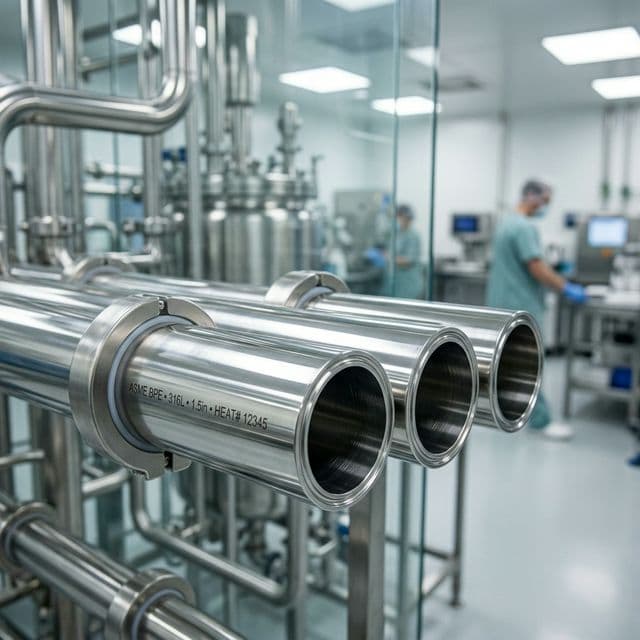
For decades, the biopharmaceutical industry has relied on stringent purity standards to ensure the safety and efficacy of life-saving medicines. At the heart of this infrastructure lies austenitic stainless steel—specifically, the 316L and 304L grades. These materials have become the gold standard due to their unique combination of weldability, corrosion resistance, and surface adaptability.
These specialized alloys are prized for their exceptional mechanical strength under extreme thermal cycles. But what truly sets them apart in biopharma is their ability to achieve ultra-smooth surface finishes, typically under 0.38 micrometers Ra (Roughness Average). Achieving this level of precision requires a deep understanding of metallurgical grain structures and cold-working techniques.
316L vs. 304L: The Strategic Choice
While both grades are austenitic, the choice between 316L and 304L often hinges on the specific chemical environment of the processing line:
- 316L (Low Carbon, Molybdenum-Enhanced): The addition of molybdenum provides superior resistance to chloride-induced pitting, making it essential for buffered solutions and saline environments commonly found in drug formulation.
- 304L (Low Carbon): Often used for high-purity water systems (WFI) where the chemical stress is lower, but the requirement for microbial control remains absolute.
Why Surface Finish Matters
In a sterile pipeline, any microscopic crevice or pit can become a breeding ground for bacteria (biofilm) or cause product entrapment. This introduces severe contamination risks that can compromise entire batches of medication.
To mitigate these risks, the industry employs a two-tier surface treatment strategy:
- Mechanical Polishing: This initial stage diminishes macroscopic roughness and prepares the surface by physically leveling the peaks and valleys of the metal's topography.
- Electropolishing (EP): A crucial secondary step that electrochemically removes the outermost layer of metal. This process not only smooths the surface further but also enriches the chromium-to-iron ratio at the surface, resulting in a rich, chromium-oxide passive layer that is exceptionally smooth, inert, and corrosion-resistant.
Future Trends: ASME BPE Standards and Beyond
As biological drugs become more complex, the standards for the hardware that produces them continue to evolve. The ASME Bioprocessing Equipment (BPE) standards are becoming more rigorous regarding "dead legs" in piping and the traceability of raw materials. Digital documentation of heat numbers and mill test reports (MTRs) is no longer a luxury—it is a regulatory necessity.
The Radiant Tubes Standard
At Radiant Tubes, our commitment goes beyond standard compliance. Our tubes undergo rigorous multi-stage electropolishing and precise dimensional calibration. Every centimeter of our biopharma-grade tubing is inspected for absolute concentricity and surface integrity, ensuring our clients receive hardware that exceeds industry expectations for years of reliable, sterile service.